
You only see a helmet and a pair of hands at 300 km/h, so it’s easy to forget that height and weight still matter in a sport obsessed with grams and millimetres. Taller drivers squeeze packaging. Shorter drivers give engineers a little more ballast freedom. Since 2019, the FIA’s 80 kg minimum for “driver + seat + kit” has levelled things out—but cockpit ergonomics, weight distribution and even visibility still play a role.
Below is the 2025 grid, tallest to shortest, plus a few spicy takeaways you can drop in the group chat.
Quick facts (2025)
- Average height: just under 1.77 m (5’9¾”) — smack in Lewis Hamilton territory.
- Tallest: Alex Albon (Williams) & Esteban Ocon (Haas) at 1.86 m.
- Shortest & lightest: Yuki Tsunoda (Red Bull) at 1.59 m / 54 kg.
- Heaviest: Lance Stroll (Aston Martin) at 79 kg.
- Tallest pairing: Haas — Ocon (1.86 m) + Bearman (1.84 m) → avg 1.85 m.
- Shortest average pairing: Red Bull — Verstappen (1.81 m) + Tsunoda (1.59 m) → avg ~1.70 m.
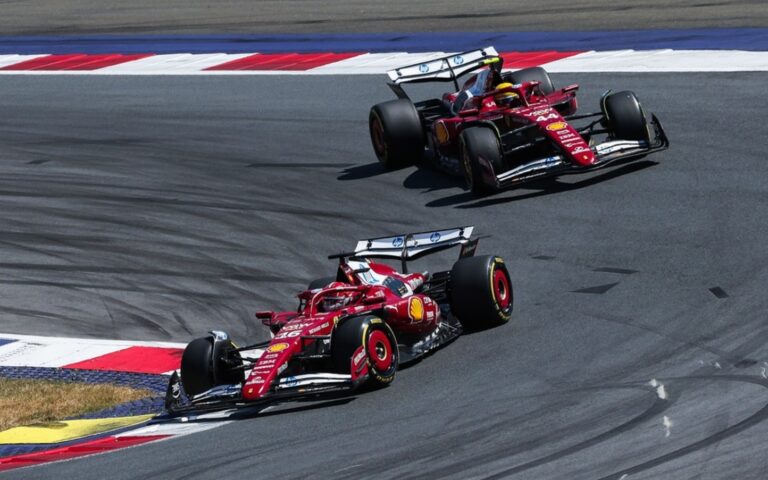
- Neat symmetry: Ferrari’s Leclerc (1.80 m, 68 kg) & Hamilton (1.74 m, 73 kg) are closely matched, which engineers love.
Why height still matters
Even with the 80 kg rule, a taller driver’s limbs, seating angle and helmet position change packaging and aero sightlines; a shorter driver can unlock ballast placement for balance. Cockpits are now standardised to ≥850 mm (length) and ≥450 mm (width), so everyone fits—but “fits” isn’t the same as “ideal.” That’s the black art.
| Driver | Team | Height (imperial) | Height (metric) | Weight |
|---|---|---|---|---|
| Alex Albon | Williams | 6 ft 1 in | 1.86 m | 66 kg |
| Esteban Ocon | Haas | 6 ft 1 in | 1.86 m | 73 kg |
| George Russell | Mercedes | 6 ft 1 in | 1.85 m | 70 kg |
| Gabriel Bortoleto | Sauber | 6 ft 0 in | 1.84 m | 71 kg |
| Nico Hülkenberg | Sauber | 6 ft 0 in | 1.84 m | 78 kg |
| Oliver Bearman | Haas | 6 ft 0 in | 1.84 m | 68 kg |
| Jack Doohan* | Alpine | 6 ft 0 in | 1.83 m | 70 kg |
| Lance Stroll | Aston Martin | 5 ft 11 in | 1.82 m | 79 kg |
| Max Verstappen | Red Bull | 5 ft 11 in | 1.81 m | 72 kg |
| Charles Leclerc | Ferrari | 5 ft 11 in | 1.80 m | 68 kg |
| Oscar Piastri | McLaren | 5 ft 10 in | 1.78 m | 68 kg |
| Carlos Sainz | Williams | 5 ft 10 in | 1.78 m | 66 kg |
| Pierre Gasly | Alpine | 5 ft 10 in | 1.77 m | 70 kg |
| Lando Norris | McLaren | 5 ft 9 in | 1.76 m | 68 kg |
| Franco Colapinto* | Alpine | 5 ft 9 in | 1.75 m | 71 kg |
| Lewis Hamilton | Ferrari | 5 ft 8 in | 1.74 m | 73 kg |
| Liam Lawson | Racing Bulls | 5 ft 8 in | 1.74 m | 72 kg |
| Andrea Kimi Antonelli | Mercedes | 5 ft 7 in | 1.72 m | 70 kg |
| Fernando Alonso | Aston Martin | 5 ft 7 in | 1.71 m | 68 kg |
| Isack Hadjar | Racing Bulls | 5 ft 6 in | 1.67 m | 65 kg |
| Yuki Tsunoda | Red Bull | 5 ft 3 in | 1.59 m | 54 kg |
Tallest & shortest: what it actually changes
- Haas (Ocon + Bearman): More leg length means tighter pedal box and seating angles. Not a dealbreaker—just design intent you feel in packaging choices.
- Red Bull (Verstappen + Tsunoda): A 22 cm gap means two very different fits. The upside? Setup experimentation across a wider ergonomic window. The downside? You’re always juggling compromises.
Bonus: the all-time bookends
- Tallest in F1 history: Hans-Joachim Stuck at 1.94 m (6’4”); Justin Wilson also reached 1.93 m—both battled cramped cockpits in the ground-effect era.
- Shortest in F1 history: Andrea Montermini at 1.57 m (5’1”). Proof the stopwatch doesn’t care how high you reach the garage shelf.
The drivertalk take
Height won’t win you a tenth by itself, but it absolutely shapes the car around the driver—and the trade-offs teams make to chase balance. In a cost-capped world with frozen sections, those trade-offs are louder than ever. It’s not about tall vs. short; it’s about how ruthlessly a team can build a fast compromise.
If you want this turned into a printable chart (team-by-team, plus averages), say the word and we’ll spin one up.